



1.What is Digital Teacher English Language Lab?
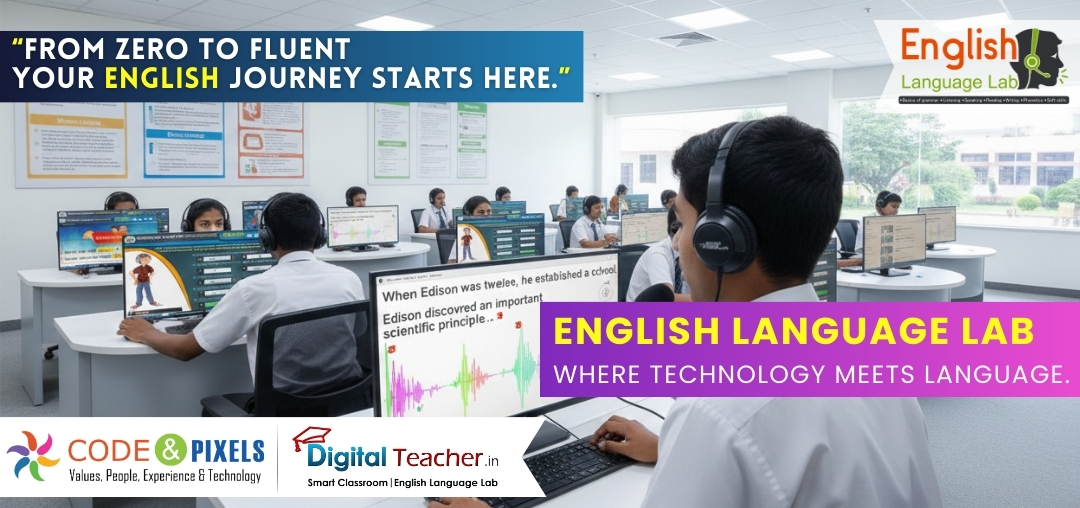
Digital Teacher English Language Lab is a software based language lab by Code and Pixels that builds English skills through interactive lessons, phonetics, soft skills, and blended learning (Teacher-led + self-practice). It is aligned to CEFR levels A1–C2 and mapped to Indian learners context, with content that covers listening, speaking, reading, writing, phonetics, vocabulary, grammar and soft skills for school and college students.
The software:
- Allows self paced learning with headphones and private practice.
- Provides teacher handbook, session planner and structured activities.
- Caters to State Board / CBSE and ELCS lab requirements, and supports placement oriented training in colleges.
2. Case Study 1 – Rural School: How the Lab Changed a Student’s Life
Context: Rural government high school using Digital Teacher English Language Lab for classes 6–10.
2.1 School Profile
- School: Sri Venkateswara ZP High School (Rural, Andhra Pradesh)
- Type: Government, Telugu medium
- Students: ~420 (6th–10th)
- Challenges before implementation
- Students could read English but rarely spoke it.
- Heavy Mother Tongue Influence (MTI) in pronunciation.
- Fear and shyness students avoided speaking even simple sentences.
- No structured environment for listening and speaking practice.
These challenges are very typical in rural India, where English is a foreign language and there is little exposure outside the classroom.

2.2 Introducing Digital Teacher English Language Lab
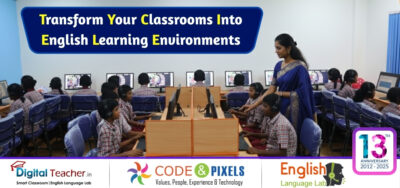
The school converted an existing computer room with 20 systems and headsets. Digital Teacher English Language Lab was installed on all systems.
Configuration:
- 20 student systems with headphones
- 4 periods per week for classes 8–10
- Blended model: Instructor Led Training (ILT) + Computer Based Training (CBT) as recommended by Digital Teacher.
Implementation Plan (First Academic Year)
| Month | Focus | Features/Modules used |
| 1–2 | A1 basics – LSRW foundation | Everyday English, basic vocabulary, short listening clips |
| 3–4 | Pronunciation & phonetics | Minimal pairs, word stress, intonation, MTI reduction |
| 5–6 | Everyday conversations | Dialogues, role-plays, situational English |
| 7–8 | Storytelling & summarising | Listening + speaking tasks, recording & playback |
| 9–10 | Soft skills introduction | Greetings, self-introduction, basic public speaking |
| 11–12 | Revision & assessment | Built-in assessments + teacher observation |
2.3 Student Story – “Anjali”: From Silent Listener to Confident Speaker
Background
- Class: 9th standard
- Family: Daily wage agricultural labourers
- Language: Telugu only at home
- Initial level: Could answer written questions, but never spoke English in class.
CEFR Level A1–A2 Modules
Anjali started with basic level modules: greetings, self introduction, everyday sentences. The system allowed her to:
- Listen to native like audio.
- Repeat and record her own voice.
- Compare her pronunciation privately without embarrassment.
Phonetics & MTI Reduction
-
- She spent extra time on sounds she found difficult (e.g., /w/ vs /v/, /s/ vs /sh/).
- Exercises on word stress, intonation, weak/strong forms helped her sound more natural.
Conversation Practice
-
- Role play activities: at the market, at the hospital, in a job interview, etc.
- Teacher used ILT activities suggested in the teacher handbook and session planner and then sent students to systems for CBT practice.
Continuous Assessment
-
- Regular small tests from the software (listening/speaking tasks).
- Teacher maintained a simple rubric: fluency, accuracy, confidence, pronunciation.

Outcomes After One Year
You can present this as a measurable impact table:
| Area | Before Lab | After 10–12 months |
| Speaking in English | Almost never; only one-word replies | Gives a 2–3 minute self-introduction and short speech in morning assembly |
| Pronunciation | Strong MTI, unclear sounds | Clearer sounds, correct word stress on most common words |
| Confidence | Would avoid eye contact, no participation | Volunteers for role-plays, speaks to visitors in English |
| Academic performance (English) | 52% in annual exam | 78% in the next annual exam |
Anecdote for the Case Study
During the school’s Science Fair, district officials visited. When asked who would explain the project in English, Anjali stepped forward. She described her model, answered questions, and even greeted them with “Good morning, respected sir, welcome to our school.” The Headmaster specifically mentioned that the English Language Lab practice enabled her to gain this confidence.
“The lab converted a shy rural student into a confident English speaker who can now dream of higher education and better opportunities.”
3. Case Study 2 – College: Upskilling Students for Interviews & Placements
Context: Engineering / Degree college using Digital Teacher English Language Lab as ELCS/Communication Skills Lab to improve employability.
3.1 Institution Profile
- Institution: GK Institute of Technology & Management
- Programmes: B.Tech / Degree (CSE, ECE, EEE, MBA etc.)
- Issue:
- Students had good technical knowledge but weak communication and poor performance in:
- HR rounds
- Group Discussions
- Technical presentations
- NAAC feedback and internal audits highlighted need to strengthen communication and soft skills.
- Students had good technical knowledge but weak communication and poor performance in:
NAAC manuals clearly state that colleges must offer Soft skills, Language and communication skills, ICT/computing skills, often through add on courses or labs.
3.2 Setting Up the Language Lab as ELCS / Communication Skills Lab
The college created a dedicated English Language & Communication Skills Lab (ELCS):
- 40 networked systems + 1 master console
- High fidelity headphones
- English language learning software (Digital Teacher English Language Lab) for self study, matching common ELCS infrastructure norms.
Integration into Curriculum
- 1st year: ELCS Lab basics of LSRW, phonetics, MTI reduction.
- 2nd year: Advanced speaking, presentations, situational communication.
- 3rd/4th year: Placement oriented soft skills + interview skills modules.
Typical ELCS lab syllabi include phonetics, MTI neutralisation, public speaking, presentations, and group discussions, exactly the areas that Digital Teacher lab covers through audio visual modules and activities.

3.3 Mapping Lab Use to Employability Skills
Digital Teacher English Language Lab offers:
- Phonetics & Pronunciation Training: stress, intonation, MTI neutralisation.
- Soft Skills: greetings, body language, email etiquette, telephone etiquette, public speaking.
- Interview & GD prep: mock interviews, extempore speaking, group interaction tasks (through ILT + CBT).
- CEFR-based progression: from A1 to C2 ensures structured upgradation right from basics to advanced fluency.
College Implementation Example
| Semester | Activities using Digital Teacher Lab | Outcome |
| 1st Year | LSRW foundation, phonetics, listening skills | Reduced MTI, better basic pronunciation |
| 2nd Year | Situational dialogues, role-plays, telephone/email etiquette | Students start using English in labs & campus activities |
| 3rd Year | Presentation skills, extempore, technical topic presentations | Stronger seminar performance |
| Final Year | Mock HR interviews, GDs, resume-building sessions using lab content as pre-work | Better performance in campus placements |
3.4 Placement Impact Story
- Student: Mahesh, B.Tech – ECE
- Problem: Cleared written tests of several companies but rejected in HR round due to poor communication skills.
- Intervention:
- Mentoring cell mapped his CEFR level as B1, he was asked to complete specific B1/B2 speaking modules in the lab.
- He recorded answers to common HR questions (self intro, strengths/weaknesses, project explanation) and refined them with help of the Communication Skills trainer.
- Attended 10 structured mock interviews in the lab – 5 technical, 5 HR-focused.
- Result:
- In the next campus drive, he cleared GD + HR and got placed in an IT services company.
- Feedback from recruiters mentioned: “candidate’s communication has improved; confident and clear in expressing ideas.”
Department Level Outcome
Over two placement seasons, the institution reported:
- Increase in first attempt placement from 58% to 72%.
- Fewer “communication skills” remarks in rejection feedback.
NAAC peer team noted the Language/Communication Skills Lab as a strength and a good practice in their report. (You can quote your actual NAAC report sentence here.)
Location
Related Ads