

English communication skills play a critical role in academic success, campus placements, and career growth, especially for students in Indian schools and colleges.
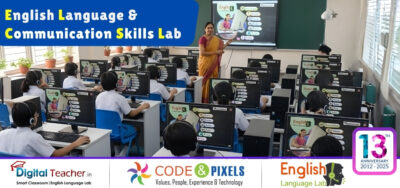
To address the growing gap between English syllabus learning and real-world communication, many educational institutions are adopting English Language Labs, also known as Digital Language Labs or Spoken English Labs.
This blog answers the most frequently asked questions about English Language Labs in India, including their benefits, software features, hardware requirements, cost of implementation, NEP 2020 compliance, NAAC and AICTE relevance, and impact on student employability.
Designed for school managements, college administrators, principals, and educators, this comprehensive FAQ guide explains how an English Language Lab helps improve speaking skills, pronunciation, listening ability, interview performance, and overall confidence among students, particularly in rural and semi-urban institutions.
General Questions:
1. What is an English Language Lab?
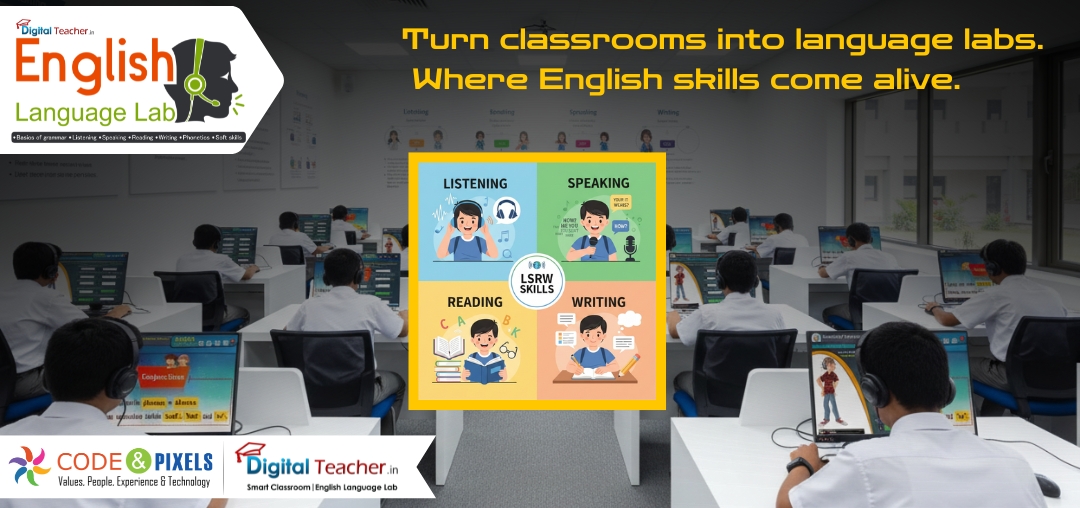
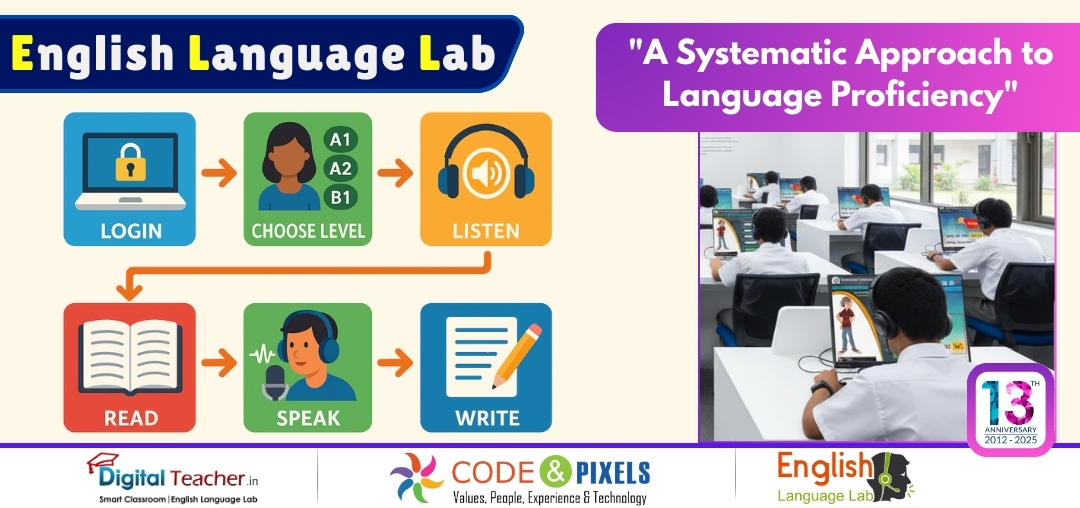
- An English Language Lab is a technology enabled learning environment that helps students improve listening, speaking, reading, writing, pronunciation, and communication skills through interactive digital content and practice based learning.
2. Why is an English Language Lab required in schools and colleges?
- Many students study English as a subject but lack speaking confidence. A language lab bridges this gap by providing structured practice, exposure, and real-life communication scenarios.
3. How does a language lab improve English communication skills?
- It uses audio, visual lessons, pronunciation drills, role plays, and assessments that allow students to hear, speak, record, compare, and improve their English continuously.
4. Is an English Language Lab mandatory as per Indian education norms?
- While not always mandatory, language labs are strongly recommended under skill development initiatives, accreditation frameworks, and NEP 2020 guidelines.
5. Difference between traditional classroom and language lab?
- Traditional classrooms focus on theory, while language labs focus on practical usage, speaking practice, listening skills, and individual learner engagement.
6. Who can use the English Language Lab?
- Digital teacher English Language Lab is suitable for school students, college students, diploma students, and even faculty development programs.
7. Is it useful for rural and semi-urban students?
- Yes. Language labs are especially beneficial for first generation english learners and rural students who lack english speaking environments.

Academic & Learning Outcomes:
8. How does it improve speaking and pronunciation?
- Students listen to native/neutral accents, record their voice, and compare pronunciation, enabling self-correction and improvement.
9. Does it reduce fear of speaking English?
- Yes. Students practice individually in a nonjudgmental environment, which builds confidence before speaking in public.
10. Can students practice all four language skills together?
- Yes. The lab integrates listening, speaking, reading, and writing in a structured manner.
11. Is content aligned with Indian syllabi?
- Yes. Most labs are aligned with CBSE, ICSE, State Boards, universities, and employability skill requirements.
12. How does it help in interview and placement preparation?
- It includes modules on group discussions, interviews, presentations, workplace communication, and soft skills.
13. Is it useful for competitive exams?
- Yes. Improved comprehension, vocabulary, and communication skills help in exams like banking, SSC, and other aptitude based tests.
14. Do slow learner’s benefit?
- Yes. Using Digital teacher English Language lab, students can learn at their own pace, repeat lessons, and practice independently.
Software & Content:
15. What software is used?
- Language labs use dedicated educational software with multimedia lessons, speech practice, assessments, and reporting tools.
16. Is the content Indian accent friendly?
- Yes. Most solutions use neutral or Indian friendly accents suitable for Indian learners.
17. Does it include grammar and vocabulary?
- Yes. Grammar, vocabulary, sentence construction, and usage are core modules.
18. Are interactive activities included?
- Yes. Role plays, dialogues, quizzes, pronunciation drills and speaking tasks are included.
19. Is content age wise structured?
- Yes. Content is divided for primary, secondary, higher secondary, and college levels.
20. Does the Lab need Teacher console and teacher to support the students?
- No. Digital teacher English Language lab does not need any teacher nor teacher console. It is very student friendly user interface hence students can practice easily on their own, without any guidance.
21. Is Soft skills and vocabulary available?
- Yes. A topic on soft skills and vast vocabulary terms are available
Hardware & Infrastructure:
22. Minimum hardware requirements?
- Basic desktop or laptop with headset, microphone, and windows 11 operating system are needed for Digital teacher English Language lab.
23. Can it run on existing computers?
- Yes. Most labs are designed to work on existing infrastructure.
24. Is internet mandatory?
- Not always. Many labs work offline after installation. During licensing internet is needed for few seconds.
25. Can it work offline?
- Yes. Offline labs are common in government and rural institutions.
26. How many students can use it at a time?
- Depends on the number of systems typically 20–40 students per batch.
27. Is a headset compulsory?
- Yes. Headsets with microphones are essential for speaking and listening practice.
28. Can it run on laptops?
- Yes, Digital Teacher English Language lab, effectively runs on Laptop.

Teacher & Administration:
29. Do teachers need special training?
- No technical expertise is required and basic training is sufficient.
30. Is training provided?
- Yes. Demo on Digital teacher English Language lab is given to teacher how to use the LAB and Video will also be shared.
31. Should teachers monitor students for better results?
- Never, Students should never be monitored for better results. Students must be guided how to use lab. If teacher monitors the lab, student again generates fear and does not show interest to use lab. The term lab means do the experiments and learn on own. Hence Labs should never monitor students.
32. Can the students practice on their own or teacher is needed?
- Yes. Students can easily practice on their own, little guidance is needed from teacher for 1 or 2 days. Later, they will do themselves.
33. Is it easy for non-technical teachers?
- Yes. Interfaces are designed to be simple and user-friendly.
34. Can we call it teacher independent or teacher less Labs?
- Yes. Certainly. No teacher is needed hence you may call it teacher less labs.
Implementation & Usage:
35. Classroom space required?
- A regular computer lab or classroom is sufficient.
36. Setup time?
- Usually 1–3 days depending on infrastructure.
37. Can it be a regular subject?
- Yes. Many institutions allocate weekly periods.
38. Is it suitable for all education levels?
- Yes, from primary schools to colleges.
39. Recommended periods per week?
- 2–3 periods per week are ideal for Digital teacher English Language lab.
Cost & Budget:
40. Cost of setting up a lab?
- Costs vary based on software, number of licenses, and hardware availability.
41. Is it affordable for government schools?
- Yes. Many cost effective and grant supported options are available.
42. Are government grants available?
- Yes, through education departments, CSR, and skill development schemes.
43. One-time or subscription?
- Both models are available depending on the vendor.
44. Are AMC charges applicable?
- Optional AMC is usually available after warranty.
45. What is the ROI?
- Improved student communication, placements, accreditation scores, and reputation.

Government Compliance & Accreditation:
46. Is it NEP 2020 compliant?
- Yes. Language labs support skill-based and experiential learning.
47. Recommended by authorities?
- Yes. Widely accepted by education departments and regulators.
48. Accepted for NAAC/NBA/NIRF?
- Yes. Counts as infrastructure and skill development initiative.
49. Can it be shown during inspections?
- Yes. It strengthens institutional assessment.
50. Does it support employability goals?
- Yes. Communication skills are core employability skills.
Support & Maintenance:
51. Is technical support provided?
- Yes. Support is included during warranty.
52. What if software crashes?
- Remote or onsite support resolves issues quickly.
53. Are updates provided?
- Yes. Regular updates improve content and features. Usually for every 2 years issues any related to content are fixed.
54. Is remote support available?
- Yes. Digital teacher English Language lab tech team can support remotely.
55. Support period?
- Typically 1 year, extendable via AMC.
Decision – Maker Questions:
56. Why not just hire teachers?
- Language labs support teachers with structured, scalable practice.
57. Improvement timeline?
- Noticeable improvement in 3–6 months with regular usage.
58. Is it just software?
- No. It is a complete learning ecosystem.
59. How is it different from others?
- Quality of content, usability, reporting, and support make the difference.
60. Is demo available?
- Yes. we provide demos on Digital teacher English Language lab.
Location
Related Ads